Key Disclosure Documents
The most significant records in the
Department of War’s PURSUE releases, with a synopsis of each, and a guide to every document by tranche
⚠ Read this first: PURSUE files are cases the government calls unresolved: it could not reach a definitive conclusion, often because of limited data. “Unresolved” does not mean “anomalous.” Significance here means historical or evidentiary interest, not proof of anything unusual.
Since May 2026 the PURSUE program has published 478 records in seven tranches. This page picks out the 15 documents or document sets that matter most — the ones with the most unusual detail, the most official weight or the most public attention — and explains each in a paragraph or two. Open a tranche below to see every document in it, with the important ones highlighted.
Browse by tranche
May 22, 2026 · 64 files
51 informally titled videos requested by Congress, Mercury astronaut audio, green fireball records
June 12, 2026 · 72 files
Federal-agent witness files from the October 2023 western event,
CIA policy records,
Project Sign, Colorado Springs
July 10, 2026 · 40 files
STS-80 shuttle photos, Project Blue Book-era records,
Pantex, Pacific and Middle East videos
Aug. 7, 2026 · 41 files
FBI triangle and western U.S. reports, AC-130 and Navy videos, Puerto Rico radar 1964, Bahia 1963 crash claim
Sept. 18, 2026 · 75 files
Tremonton film,
Ruppelt briefing,
AAWSAP contract papers and DIRDs, CENTCOM and Colorado videos
Oct. 23, 2026 · 28 files
2026 triangle report,
BAASS program records, 1950s Air Force intelligence reports, space-fragments memos
New in Release 07 (October 23, 2026)
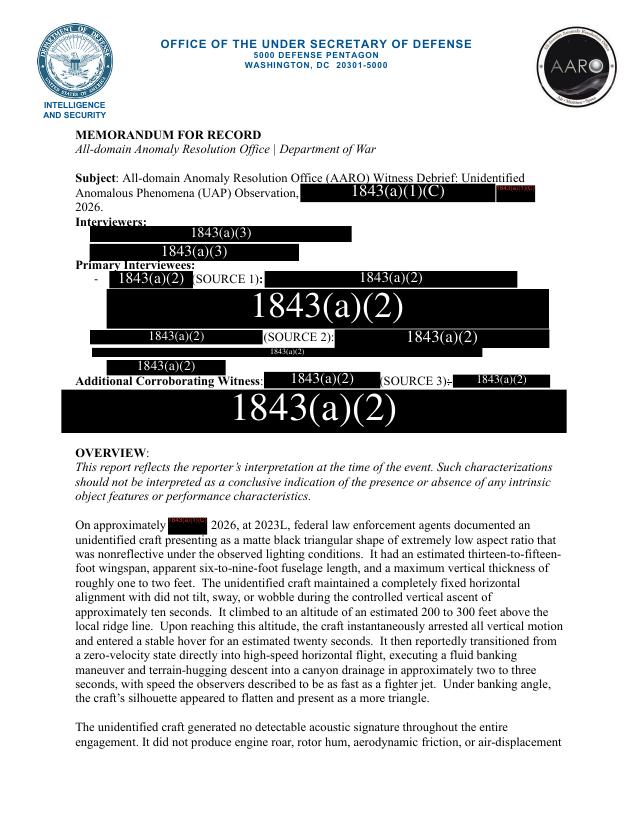
1. A silent black triangle that hovered and dove into a canyon (2026)
An AARO witness debrief and an FBI FD-302 describe federal law-enforcement personnel watching, at dusk in 2026, a matte-black triangle about 13–15 feet across. They say it rose vertically for about ten seconds, hovered for about twenty, then banked and dropped into a canyon in two to three seconds at what they called fighter-jet speed. There was no sound, no exhaust and a uniform thermal signature in infrared.
A ground survey the next morning found nothing. The witnesses were already running sensors and said a conventional drone at that range would have been audible, but no instrument measured the speed and no recording was released.
Why it matters: It is the newest incident in the releases and the one drawing the most public attention, but it is a single group’s account with the date, place and names redacted.
Full case page · AARO · FBI
2. BAASS Project Management Plan: what the contractor believed and asked for (2008)
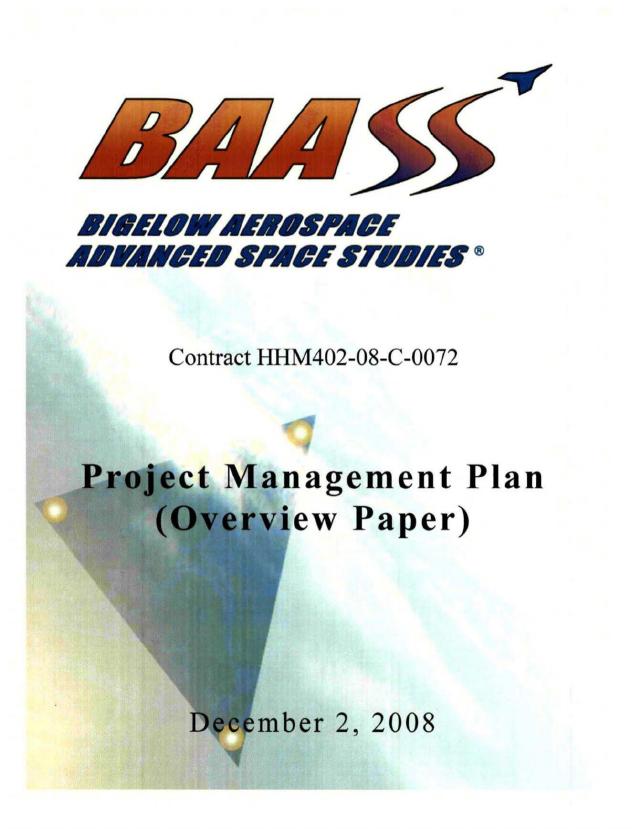
Cover of the BAASS Project Management Plan (DOW-UAP-D168). U.S. Department of War.
Dated December 2, 2008, this 49-page plan was written by Bigelow Aerospace Advanced Space Studies for the Defense Intelligence Agency under contract HHM402-08-C-0072. It lays out nine projects across twelve technical areas, from physics papers to a plan to attempt “contact” at sites with recurring activity, and treats advanced craft as established for more than 60 years.
It asks the sponsor for security clearances, gun-camera and satellite film, Brazilian Air Force files and access to alleged biological samples held by military laboratories, says “several crashes” occurred outside the U.S., and includes an affidavit-style exhibit about Roswell. It records claims and intentions, not evidence.
Why it matters: It is the clearest first-hand statement of what the AAWSAP-era contractor wanted to do and what it assumed to be true.
BAASS records page · AAWSAP contract papers (Release 06) · BAASS
Cover of the BAASS self-assessment report (DOW-UAP-D175). U.S. Department of War.
The 141-page November 23, 2010 report summarizes what BAASS built: field sensors, an 11-database data warehouse and engineering simulations. Its worked example is the November 2004 Nimitz carrier group encounter, for which it reproduces an excerpt of a DIA investigation: radar detections by USS Princeton, an intercept by F/A-18F crews and a white object of roughly 40–46 feet over a disturbance in the water.
The DIA key assessments say no known aircraft in the inventory matched and that the object was low-observable. BAASS then calculates speeds near Mach 10 and about 75 g from an assumed five-second descent. Those figures are assumptions, since no duration is known.
Why it matters: It ties the Tic Tac case to a DIA assessment and shows the contractor’s end-state capabilities.
BAASS records page · Project Capella · DIA
4. Skinwalker Ranch: the November 2009 report and the Utah ranch investigation (2009–2010)
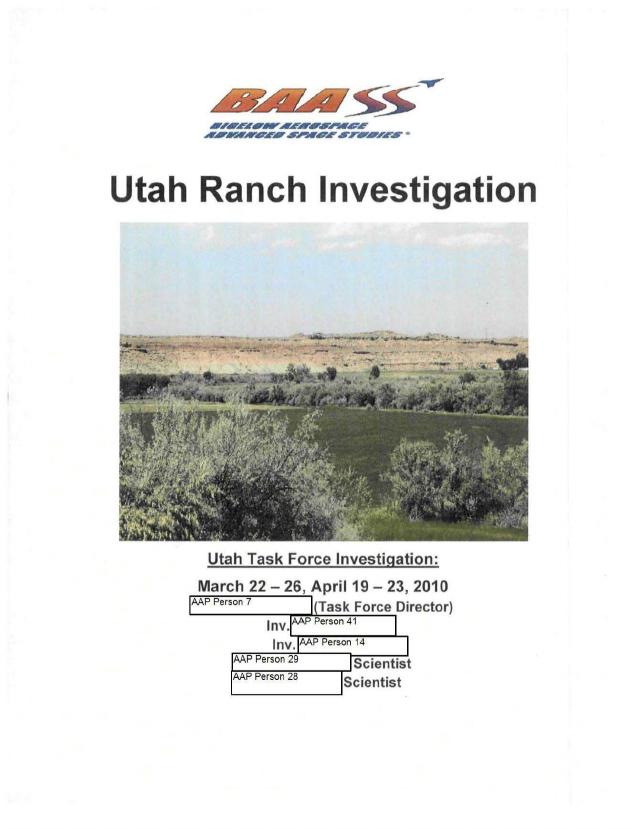
Utah ranch investigation report (DOW-UAP-D174). U.S. Department of War.
The November 2009 BAASS monthly report is the only document in the release to name Skinwalker Ranch. It says BAASS kept round-the-clock security patrols on the property from August 3, 2009, quotes guard logs about a stereo that turned itself on, and describes tamper-proof experiments. BAASS itself says the officers’ anecdotes could be explained by fraud or trespassers.
The April 2010 Utah ranch report adds more than 25 interviews about dog-like bipeds and orbs and a hair analysis widely summarized as “raccoon.” In fact the fence hairs matched a domestic dog and a hair in a rock matched a raccoon. Neither report produced hard physical evidence.
Why it matters: They are official confirmation that a Pentagon contractor ran surveillance and experiments at the ranch, and an example of how little instrument data came out of it.
Utah ranch case page · BAASS records page · Skinwalker Ranch
5. Guam, 1956: a pilot circled by a blinking light (1957 report)
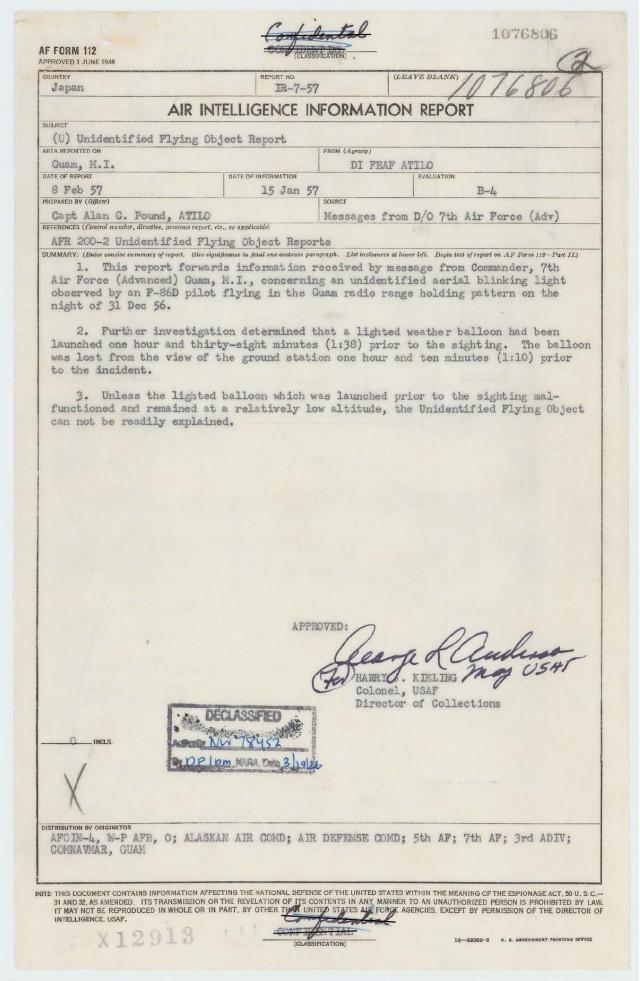
Air Intelligence Information Report on the Guam sighting (DOW-UAP-D156). U.S. Department of War.
On the night of December 31, 1956, an F-86D interceptor pilot in the Guam holding pattern reported a small white blinking light that matched his turns, climbed above him and circled him for about ten minutes while he used afterburner and still could not close on it. A lighted weather balloon had been launched earlier.
The report concludes that unless that balloon malfunctioned and stayed low, the object “can not be readily explained.” The pilot, questioned again, rejected the balloon idea.
Why it matters: It is the strongest of ten 1950s Air Force intelligence reports in the release: a trained pilot, a long encounter and an explicit explanation test that is left open.
Case page for all ten reports
6. Sweden, 1953: an airline crew and a metallic sphere (1954 report)
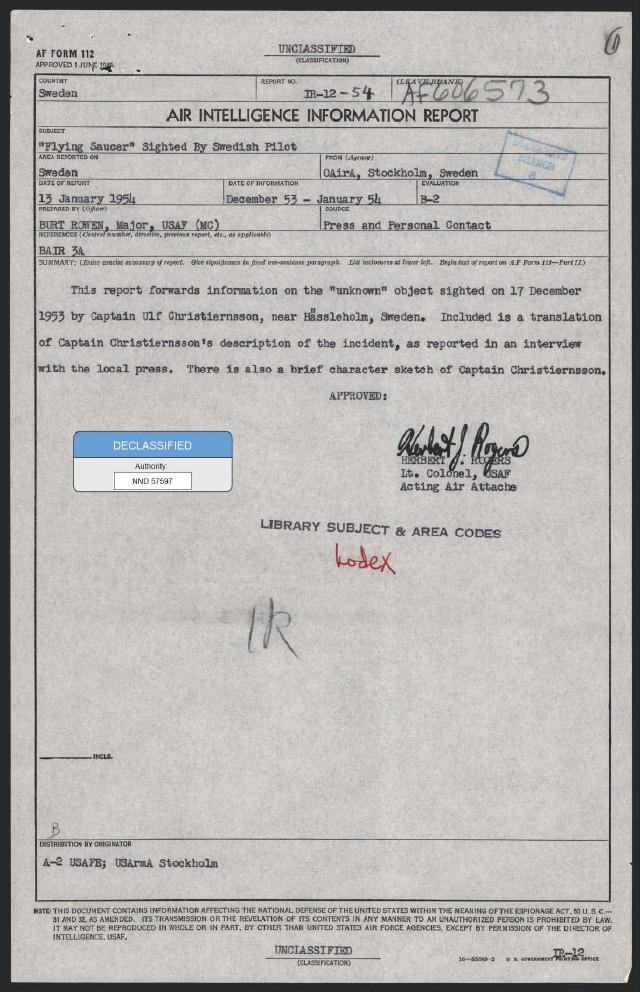
Air Intelligence Information Report on the Swedish sighting (DOW-UAP-D163). U.S. Department of War.
A U.S. air attaché in Stockholm forwarded press accounts of a Transair DC-3 crew that, on December 17, 1953, saw a shiny, nearly round metallic object pass in the opposite direction about 600 meters below, at roughly the speed of sound and visible for six to seven seconds, with no exhaust or trail. Swedish defense staff said no Swedish aircraft were in the area.
The attaché added a secondhand note questioning the pilot’s reliability, so the document records both a credible-looking airline sighting and a skeptical U.S. evaluation.
Why it matters: Two airline-crew witnesses and official Swedish statements make it one of the better-documented foreign cases in the Air Force files.
Case page for all ten reports
7. Space vehicle fragments: who would handle recovered debris (1962–1964)
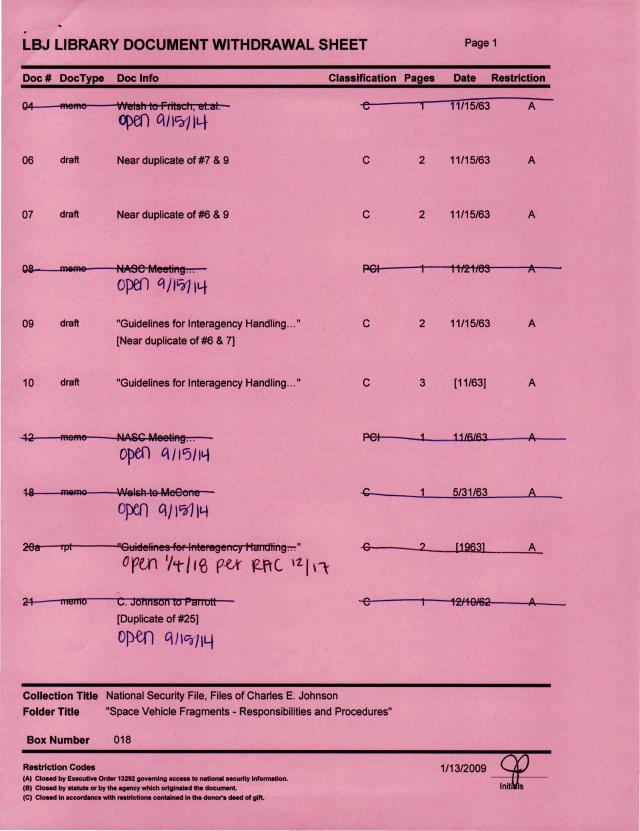
First page of the LBJ Library folder (USG-UAP-D002). U.S. Department of War.
A 72-page White House and National Aeronautics and Space Council file records how Washington worked out who should receive, analyze and identify fragments of space vehicles. NASA became the lead agency, but the Defense Department wanted foreign fragments, “including whole vehicles,” sent to it first for intelligence analysis, and the CIA objected.
A one-page May 1963 memo from the Space Council staff says NASA’s representative thought the Defense Department and Air Force “want to use NASA for a ‘cover.’” Neither document mentions UFOs.
Why it matters: It is the closest thing in the release to a government procedure for handling a recovered foreign or unidentified object, but it is about satellite and booster debris, not UAP.
Case page · Edward C. Welsh · National Aeronautics and Space Council
Highlights from Releases 01–06
8. The FBI’s complete “Flying Discs” file (1947–1968)
File 62-HQ-83894 is the FBI’s headquarters case file on flying discs and UFOs from June 1947 to July 1968. The Bureau briefly helped the Army Air Forces check sightings in summer 1947, then mostly forwarded reports to the Air Force. The release publishes the complete file in ten sections, which the Department of War says includes several newly declassified pages and only minor redactions compared with the FBI’s public Vault.
Two separate Detroit field-office records are included, a 1958 memo about a “circular object with a crystal-type dome” and a 1957 interview with a man who described a large circular vehicle rising near a German military site in 1944.
Why it matters: It is the most complete government file on how the FBI handled the first flying-saucer wave.
Full case page · FBI
9. Federal agents and the western U.S. orbs event (October 2023)

FBI digital rendering from the release. U.S. Department of War.
Over two days in October 2023, seven federal employees, most of them federal law-enforcement special agents, separately reported unusual phenomena near a sensitive national-security site in the western United States: “orbs launching other orbs,” a large stationary glowing orb, a pursuit of a large object near the ground, and a large, seemingly transparent object they likened to a “translucent kite.”
A one-page summary appeared in Release 01. Release 03 added AARO’s June 2026 analysis update, five first-hand narratives, ten FBI renderings and two video recreations.
Why it matters: Multiple trained federal witnesses, an AARO analysis and FBI renderings make it among the best-documented recent cases.
Full case page · AARO
10. Apollo and Skylab: Aldrin’s debriefing and the lunar photos (1969–1974)
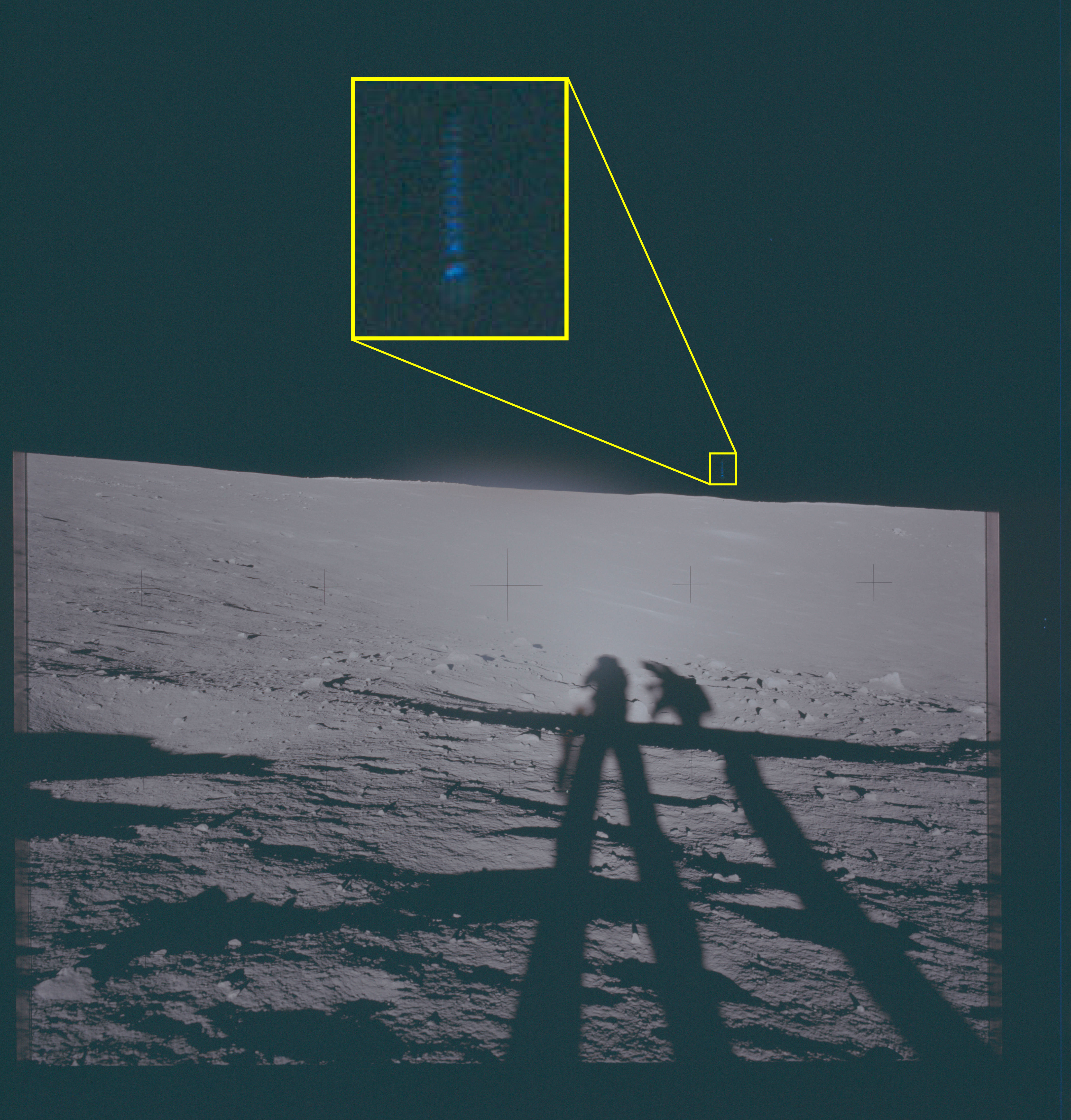
Apollo 12 lunar surface photograph from the release. NASA / U.S. Department of War.
The Apollo and Skylab records released across Releases 01 to 04 include Buzz Aldrin’s Apollo 11 debriefing about an object of “a sizeable dimension” seen a day from the Moon, flashes inside the cabin, Apollo 12 and 17 air-to-ground transcripts, debriefings on the “light flash phenomena” and Skylab crew observations.
Six lunar-surface photographs have areas of “unidentified phenomena” highlighted by the government, and one Apollo 17 image of three dots in a triangular pattern is now an open case with “no consensus” explanation.
Why it matters: It collects astronaut testimony and photos in one place and includes a government photo case it still lists as open.
Full case page · NASA
11. UAP videos requested by Congress, including the Lake Huron shootdown (2026)
On March 6, 2026, eight members of the House asked the Department of War and the intelligence community for 51 potentially UAP-related records. AARO found a matching collection of videos on a classified network, uploaded by users between 2019 and 2024 with informal titles such as “Spherical UAP Erratic movement” and “UFOs in formation over Persian Gulf?”
All 51 were released in Release 02. They include Persian Gulf “formations,” a 2017 Kabul clip, AFRICOM and EUCOM footage, and the February 2023 F-16 shootdown over Lake Huron. AARO warns that many lack a substantiated chain of custody.
Why it matters: The release is the clearest example of Congress prompting disclosure, but the clips are unvetted and mostly lack reports.
CENTCOM, AFRICOM and EUCOM clips · U.S. and INDOPACOM clips
12.
CIA records on the Robertson Panel and UFO policy (1950–1971)
CIA records on the 1953 Robertson Panel, the group of scientists that reviewed the Air Force UFO evidence, and on how its conclusions were transmitted to the Air Force. The set also covers 1952 British UFO efforts, the 1953 status of the Air Force project, a 1958 “space message” letter, Blue Book Special Report 14 and a 1971 Australian review.
Together they document the CIA’s role in shaping the government’s public posture on UFOs in the 1950s.
Why it matters: The Robertson Panel’s recommendations underlie decades of official policy on UFO reports.
Full case page · Robertson Panel
13. Puerto Rico radar incident (1964)
On November 19, 1964, near Puerto Rico, a U.S. Navy pilot reported a delta-shaped object about the size of a jet fighter moving at an estimated Mach 3, while the radar of the guided-missile destroyer USS Gyatt tracked a contact at more than 3,800 knots for 21 minutes. CIA memoranda between the heads of Special Activities and Scientific Intelligence, and briefing notes for an assistant to the CIA Director, discuss it.
The CIA’s scientific intelligence chief suggested the object was conceivably associated with foreign intelligence gathering given U.S. missile testing in the area; fast radar tracks of the era could also come from equipment errors or atmospheric effects.
Why it matters: A military pilot and ship radar agree on an extraordinary speed, and the CIA took it seriously enough to brief the Director’s staff.
Full case page · Incident page
14. The Tremonton film (1952)
About 30 feet of 16mm color film shot on July 2, 1952 by Navy photographer Delbert Newhouse near Tremonton, Utah, showing 12 to 14 bright, reflective objects moving in a loose group. It became one of the most studied pieces of evidence in Project Blue Book, and Release 06 republished the film with the Air Force file and a 1953 Navy photo-interpretation memo.
The Navy analysis concluded the objects did not match natural phenomena or known aircraft, while the Air Force file ultimately favored seabirds, a conclusion that remains disputed.
Why it matters: It is a primary piece of photographic evidence from the Blue Book era with competing official analyses.
Full case page · Navy film analysis (1953)
15.
AAWSAP contract records and 37 DIRDs (2008–2011)
The Advanced Aerospace Weapon System Applications Program (AAWSAP) was a Defense Intelligence Agency contract, pushed by Senator Harry Reid and run by Robert Bigelow’s BAASS, to study possible future aerospace threats, including UAP. Release 06 published 44 of its documents: the 2008 statement of objectives, the solicitation and award, five contract modifications and all 37 Defense Intelligence Reference Documents (DIRDs), on topics from metamaterials to warp drives.
Release 07 followed with the contractor’s own records, so the two releases together show both the sponsor’s framing and the contractor’s work.
Why it matters: It is the official paper trail behind the best-known publicly funded UAP research program.
Full case page · BAASS program records (Release 07)
How these were chosen
Documents were ranked on four things: how detailed and specific the account is, how credible and numerous the witnesses are, how much official analysis or other data accompanies it, and how much attention it has drawn. Several items are sets of related documents, so “15” counts topics, not individual PDFs. Documents with no UFO content, such as the McCoy personnel record, are described on their tranche pages but not on this list. If a new release changes the picture, this page will be updated.
Every document, by tranche
Each tranche page lists all of its documents with incident date, location, agency and links to the original files.
- Release 01 (May 8, 2026) — 158 files. The first release: FBI flying-discs file, NASA mission records, State Department memos, CENTCOM reports and the first AARO cases.
- Release 02 (May 22, 2026) — 64 files. 51 informally titled videos requested by Congress, Mercury astronaut audio, green fireball records.
- Release 03 (June 12, 2026) — 72 files. Federal-agent witness files from the October 2023 western event, CIA policy records, Project Sign, Colorado Springs.
- Release 04 (July 10, 2026) — 40 files. STS-80 shuttle photos, Project Blue Book-era records, Pantex, Pacific and Middle East videos.
- Release 05 (Aug. 7, 2026) — 41 files. FBI triangle and western U.S. reports, AC-130 and Navy videos, Puerto Rico radar 1964, Bahia 1963 crash claim.
- Release 06 (Sept. 18, 2026) — 75 files. Tremonton film, Ruppelt briefing, AAWSAP contract papers and DIRDs, CENTCOM and Colorado videos.
- Release 07 (Oct. 23, 2026) — 28 files. 2026 triangle report, BAASS program records, 1950s Air Force intelligence reports, space-fragments memos.
See also
References
- ^ U.S. Department of War (2026). PURSUE releases 01 to 07 and the UAP records index. war.gov/ufo.
Source: U.S. Department of War, PURSUE (Presidential Unsealing and Reporting System for UAP Encounters),
war.gov/ufo. Official records are U.S. government works in the public domain; summaries and analysis on this page are by UFO UAP Wiki.