NASA Apollo and Skylab Observations (1969–1974) – PURSUE Files
| Apollo & Skylab observations | |
| Missions | Apollo 11, 12, 14, 16, 17; Skylab (1973–1974) |
|---|---|
| Astronauts | Buzz Aldrin, Pete Conrad, Alan Bean, Dick Gordon, Gene Cernan, Harrison Schmitt, Ron Evans, Skylab crews |
| Agency | NASA, Department of War |
| Released | Release 01 (May 8, 2026); Release 02 (May 22, 2026); Release 04 (July 10, 2026); Release 03 (June 12, 2026) |
| Files | 20 (PDF, Image, Audio (DVIDS)) |
| Previously public? | Mostly yes — Apollo transcripts and photos are long public; the highlighted images, Apollo 17 case and several audio debriefings are new |
| Official releaseHistoricalUnder review | |
This page gathers the Apollo and Skylab material released across PURSUE Releases 01 to 04. It includes Buzz Aldrin‘s Apollo 11 debriefing about an object with “a sizeable dimension” seen a day from the Moon, flashes inside the cabin and a bright light on the way home; Apollo 12 and 17 air-to-ground transcripts and audio of lights and particles; debriefings in which astronauts discuss the “light flash phenomena”; Skylab crew observations; and six lunar-surface photographs from Apollo 12 and 17 with areas of “unidentified phenomena” highlighted by the government.[1]
One image is now an open case. The Department of War says that in an Apollo 17 photo from December 1972, three dots in a triangular pattern in the lunar sky have “no consensus” explanation; new preliminary analysis suggests they are “potentially the result of a physical object in the scene,” and the government has obtained the original film for a full NASA and Department of War study.[1]
The records
NASA-UAP-D004, Apollo 11 Technical Crew Debriefing, 1969
Open NASA-UAP-D004 (PDF) on war.gov →
Apollo 11 was the third crewed mission to the Moon and the first to land Astronauts on the lunar surface. This document is an excerpt from the Apollo 11 Technical Crew Debriefing (Volumes 1 and 2) from July 31, 1969. The document highlights three observations: one, an object on the way out to the Moon; two, flashes of light inside the cabin; and three, a sighting on the return trip of a bright light tentatively assumed by the crew to be a laser.
• Page 6-33 (Vol. 1). [Lunar Module Pilot for Apollo 11, Buzz Aldrin]: “The first unusual thing that we saw I guess was 1 day out or something pretty close to the moon. It had a sizeable dimension to it, so we put the monocular on it.” The crew speculated that it could have been the S-IVB stage of the Saturn V launch vehicle.
• Page 6-37 (Vol. 1). [Lunar Module Pilot for Apollo 11, Buzz Aldrin] “The other observation that I made accumulated gradually. I don’t know whether I saw it the first night, but I’m sure I saw it the second night. I was trying to go to sleep with all the lights out. I observed what I thought were little flashes inside the cabin, spaced a couple of minutes apart…”
• Page 21-1 (Vol. 2). [Lunar Module Pilot for Apollo 11, Buzz Aldrin] “I observed what appeared to be a fairly bright light source which we tentatively ascribed to a possible laser.”— Official PURSUE description
NASA-UAP-D001, Apollo 12 Transcript, 1969
Open NASA-UAP-D001 (PDF) on war.gov →
Apollo 12 was the fourth crewed U.S. mission to the Moon and the second to land astronauts on the lunar surface. This document is an excerpt from the Apollo 12 Technical Air-to-Ground Voice Transcription, November 1969, highlighting two periods in which astronauts reported observing unidentified phenomenon: a one hour period on the fifth day, and a two minute period on the sixth day. These transcripts contain contemporaneous observations by the flight crew reacting to unidentified phenomenon.
• Day 05, Hour 19, Minute 14, Second 58 through Day 05, Hour 20, Minute 12, Second 14:
o At 05:19:27:25, the pilot of the Lunar Module (LMP-LM), Astronaut Alan L. Bean, described observing particles and flashes of light “sailing off in space” via the onboard Alignment Optical Telescope (AOT). He characterized these phenomenon as “escaping the Moon.”
• Day 06, Hour 00, Minute 21, Second 42 through Day 06, Hour 00, Minute 23, Second 33:
o Mission Commander, Charles “Pete” Conrad, described observing floating debris outside the lunar module, which had been illuminated by the module’s onboard tracking light. At 06:00:21:51, Conrad assessed that the tracking light had burnt out because he could no longer see the debris from the module.— Official PURSUE description
NASA-UAP-VM001, Apollo 12, 1969
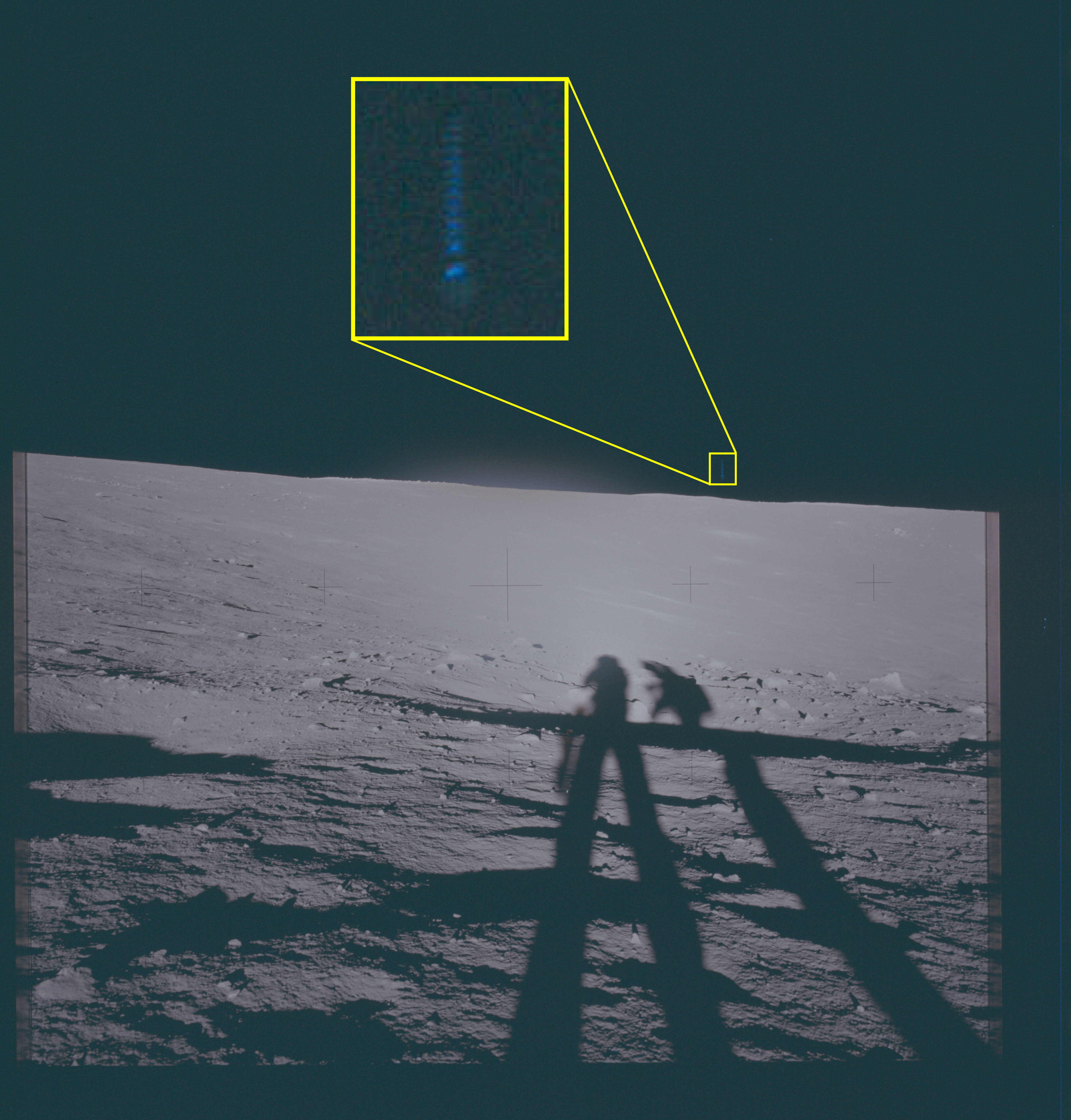
This archival photograph depicts the lunar surface as viewed from the landing site of Apollo 12. This image features a highlighted area of interest slightly to the right of the vertical axis of the frame, above the horizon, in which unidentified phenomena are visible.
This image has been modified from its original state to assist viewers in identifying specific areas of interest. These highlights are provided for contextual purposes only. Such alterations do not constitute an analytical judgment, investigative conclusion, or factual determination regarding the nature or significance of the subject matter.
— Official PURSUE description
NASA-UAP-VM002, Apollo 12, 1969
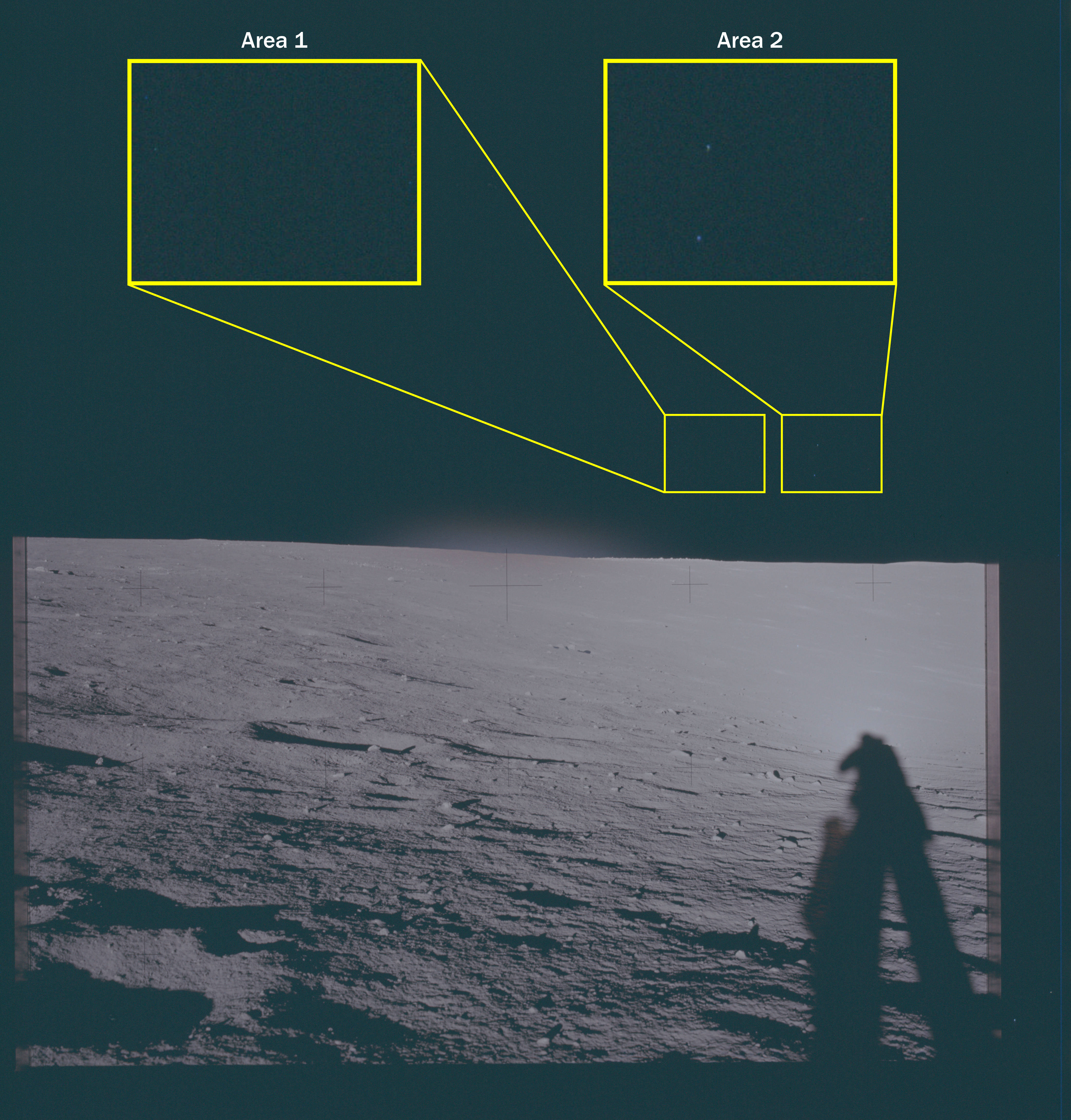
This archival photograph depicts the lunar surface as viewed from the landing site of Apollo 12. This image features two highlighted areas of interest, labeled “Area 1” and “Area 2,” slightly to the right of the vertical axis of the frame, above the horizon, in which unidentified phenomena are visible.
This image has been modified from its original state to assist viewers in identifying specific areas of interest. These highlights are provided for contextual purposes only. Such alterations do not constitute an analytical judgment, investigative conclusion, or factual determination regarding the nature or significance of the subject matter.
— Official PURSUE description
NASA-UAP-VM003, Apollo 12, 1969
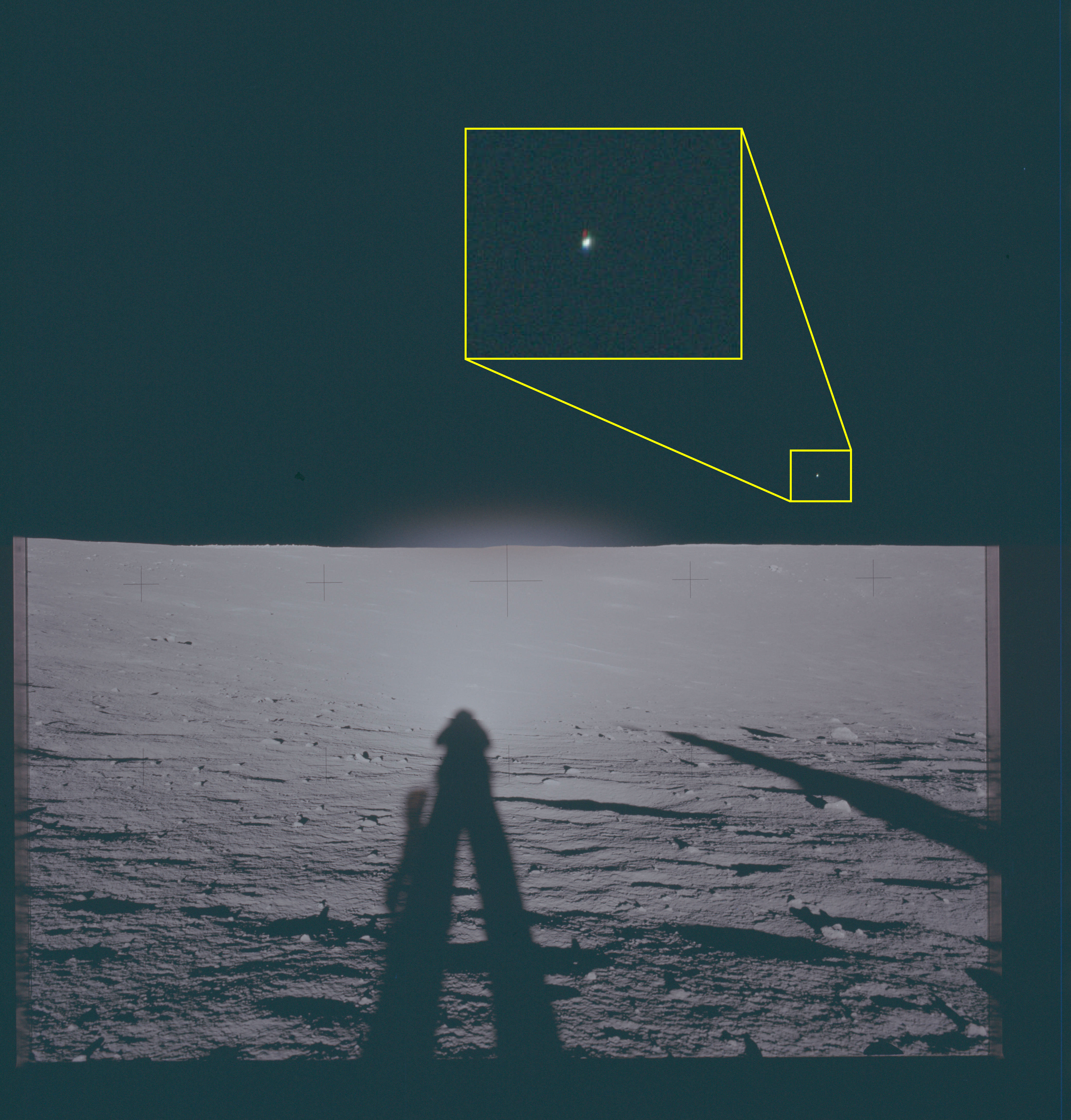
This archival photograph depicts the lunar surface as viewed from the landing site of Apollo 12. This image features a highlighted area of interest near the right edge of the frame, above the horizon, in which unidentified phenomena are visible.
This image has been modified from its original state to assist viewers in identifying specific areas of interest. These highlights are provided for contextual purposes only. Such alterations do not constitute an analytical judgment, investigative conclusion, or factual determination regarding the nature or significance of the subject matter.— Official PURSUE description
NASA-UAP-VM004, Apollo 12, 1969
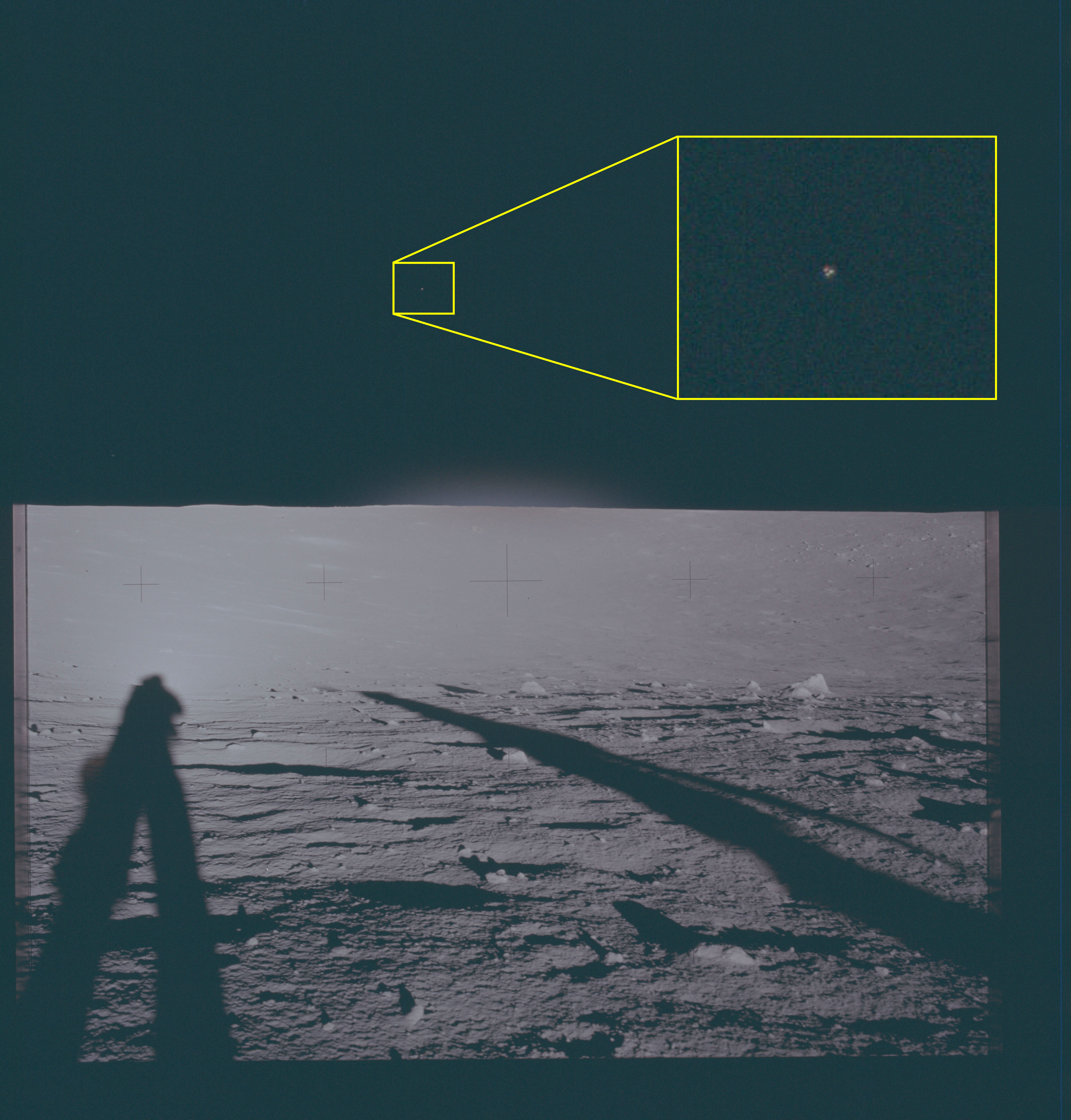
This archival photograph depicts the lunar surface as viewed from the landing site of Apollo 12. This image features a highlighted area of interest slightly to the left of the vertical axis of the frame, above the horizon, in which unidentified phenomena are visible.
This image has been modified from its original state to assist viewers in identifying specific areas of interest. These highlights are provided for contextual purposes only. Such alterations do not constitute an analytical judgment, investigative conclusion, or factual determination regarding the nature or significance of the subject matter.— Official PURSUE description
NASA-UAP-VM005, Apollo 12, 1969
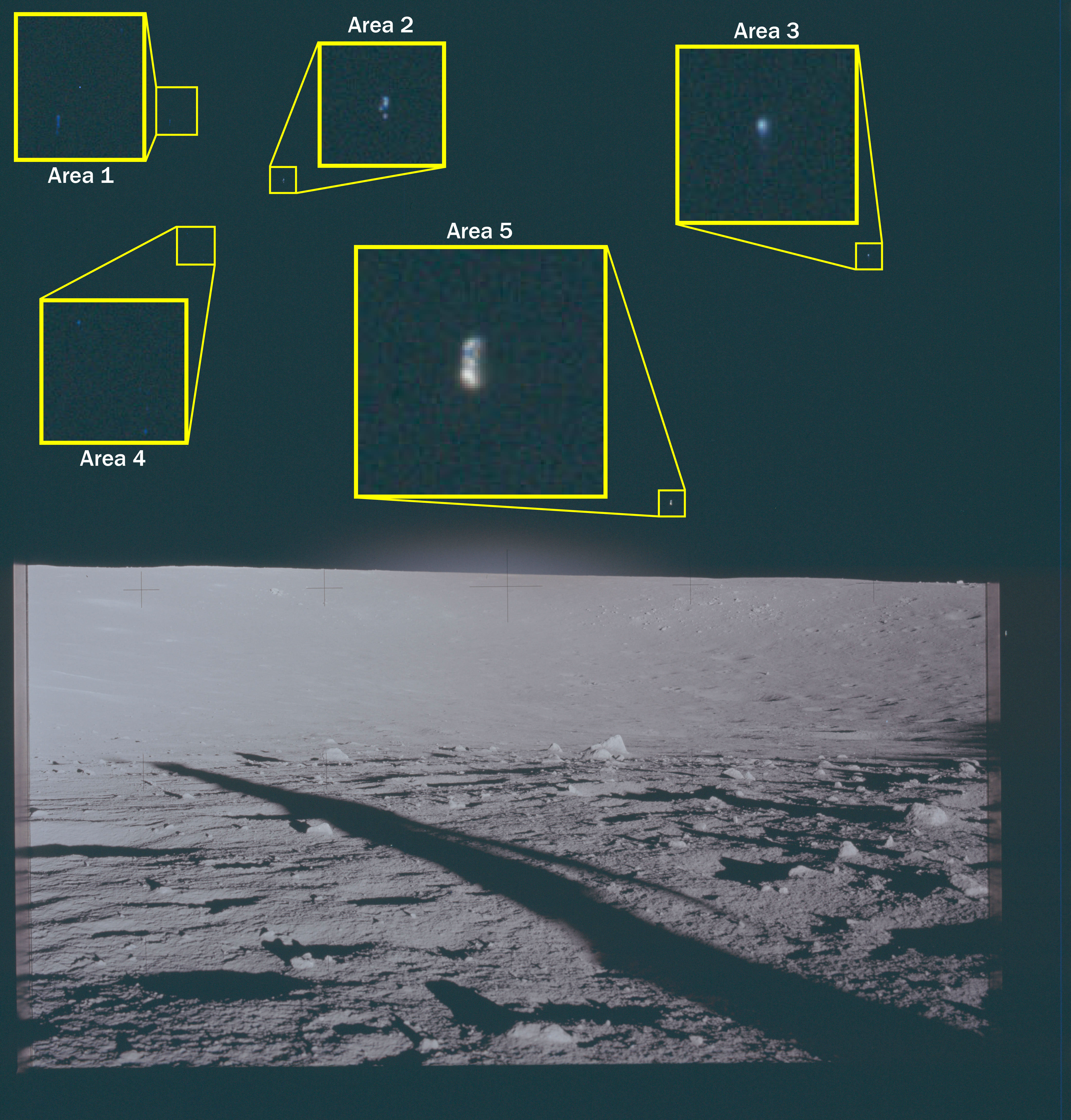
This archival photograph depicts the lunar surface as viewed from the landing site of Apollo 12. This image features five highlighted areas of interest, labeled “Area 1” through “Area 5,” above the horizon, in which unidentified phenomena are visible.
This image has been modified from its original state to assist viewers in identifying specific areas of interest. These highlights are provided for contextual purposes only. Such alterations do not constitute an analytical judgment, investigative conclusion, or factual determination regarding the nature or significance of the subject matter.— Official PURSUE description
NASA-UAP-D008, Apollo 12 Medical Debriefing – Tape 12, 1969
NASA-UAP-D008, Apollo 12 Medical Debriefing – Tape 12, 1969 — official upload on DVIDS (public domain).
During a medical debriefing of the crew of the Apollo 12 mission, Commander Charles “Pete” Conrad, Command Module Pilot Richard “Dick” F. Gordon, and Lunar Module Pilot Alan L. Bean describe their observations of instances of light flashes or “streaks of lights.” The astronauts each reported that these experiences occurred in the dark as they tried to sleep.
The NASA medical team considered whether similar phenomena reported by Apollo 11 Lunar Module Pilot Buzz Aldrin had been attributable to exposure of the retina by cosmic rays. NASA later determined that the phenomena reported by the Apollo 12 flight crew were internal to the astronauts’ vision rather than external light sources.— Official PURSUE description
NASA-UAP-D002, Apollo 17 Transcript, 1972
Open NASA-UAP-D002 (PDF) on war.gov →
Apollo 17 was the ninth crewed U.S. mission to the Moon, and the sixth to land astronauts on the lunar surface. This document is an excerpt from the Apollo 17 Technical Air-to-Ground Voice Transcription, December 1972, highlighting three periods in which astronauts reported observing unidentified phenomenon: a nine minute period on the first day, a three hour period on the second day, and a six minute period on the third day.
• Day 00, Hour 03, Minute 34, Second 10 through Day 00, Hour 03, Minute 42, Second 29:
o Command Module Pilot (CMP), Ronald Evans, reported observing “very bright particles or fragments” drifting and “tumbling” near the spacecraft as it maneuvered. Lunar Module Pilot (LMP), Harrison “Jack” Schmitt, described the phenomenon as looking “like the Fourth of July.” The astronauts speculated that the phenomenon may be attributable to ice or paint fragments dislodging from a separated component of the spacecraft (S-IVB) but characterized that assessment as a “wild guess.”
• Day 02, Hour 18, Minute 42, Second 34 through Day 02, Hour 21, Minute 07, Second 05:
o Mission Commander, Eugene A. Cernan, reported difficulty sleeping and described having observed “some sets of the streaks.” He also described an intense light flashing between his eyes, describing its intensity as comparable to that of a train headlight and characterizing it as “imposing.” Over the next three hours, Cernan described observing several flashing, rotating phenomenon that he assessed as corresponding to physical objects in space rather than a purely optical phenomenon. LMP Schmitt also reported observing similar phenomenon, though he again assessed the source of his observation to be a separated rocket stage (S-IVB). At 02:20:55:22, Cernan reported observing two additional distant flashing objects, though he assessed them as Spacecraft/Lunar Module Adapter panels (SLA panel), another separated component of the Saturn V rocket.
• Day 03, Hour 15, Minute 33, Second 25 through Day 03, Hour 15, Minute 39, Second 46:
o At 03:15:38:09, LMP Schmitt exclaimed that he had observed a flash on the lunar surface north of Grimaldi (crater).— Official PURSUE description
NASA-UAP-D009, Apollo 17 Audio Excerpt, December 7, 1972
NASA-UAP-D009, Apollo 17 Audio Excerpt, December 7, 1972 — official upload on DVIDS (public domain).
During the eleventh and final crewed mission in the Apollo program, Apollo 17 Commander Gene Cernan, Lunar Module Pilot Harrison Schmitt, and Command Module Pilot Ronald Evans report seeing small lights outside the Apollo spacecraft during transit to the moon.
The crew describe bright “particles” or “fragments” as being “jagged,” “angular,” and drifting near the Apollo spacecraft and the separated Saturn S-IVB stage. The Apollo 17 crew speculate that paint chips or ice chips are likely the source of these lights and note that they “twinkle” and move away from the Saturn S-IVB stage.— Official PURSUE description
NASA-UAP-VM006, Apollo 17, 1972
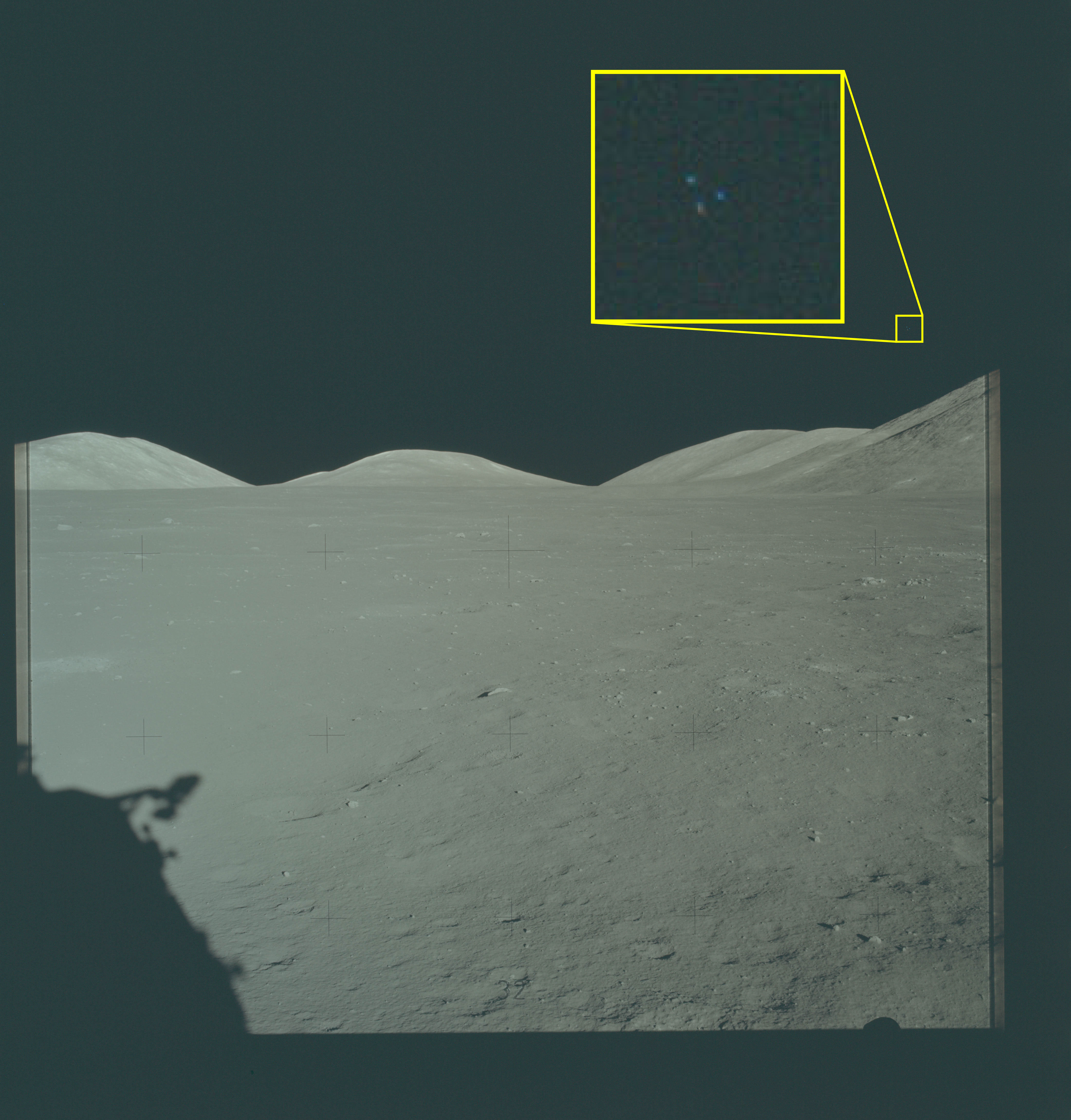
As part of the review of historical UAP materials under PURSUE, DOW has opened a case to investigate the accompanying NASA photograph from the Apollo 17 mission, taken December 1972. The image contains three “dots” in a triangular formation in the lower right quadrant of the lunar sky that is clearly visible upon magnification of the image. While this photo has been previously released and discussed by keen observers, there is no consensus about the nature of the anomaly. New preliminary US government analysis suggests the image feature is potentially the result of a physical object in the scene. Additionally, as part of this investigation, the government has obtained the original film from the Apollo 17 mission and the results of the full NASA and DOW analysis will be released when completed.
— Official PURSUE description
NASA-UAP-D005, Apollo 17 Crew Debriefing for Science, 1973
Open NASA-UAP-D005 (PDF) on war.gov →
Apollo 17 was the ninth crewed U.S. mission to the Moon, and the sixth to land Astronauts on the lunar surface. This document is an excerpt from the Apollo 17 Crew Debriefing for Science on January 8, 1973, in which Dick Henry, co-investigator on the ultraviolet experiment on Apollo 17, discusses seeing results that were unexpected.
• Pages 119-120. “One of the most exciting results of X-ray astronomy was the fact that an X-ray background was observed over the sky that nobody had expected, and part of this is the gamma-ray background that Dr. Trombka talked about. In the UV, nobody knows, but you never know until you look. You do have to deal with this background of stars that we know is there. So, we did look at a large number of different points at high galactic latitudes, both north and south. The spectrum that we see is above this dark count. In other words, this abnormally high dark current did not, in fact, interfere with that experiment. The spectrum that we see looks like the spectrum of the hot star; however, we know that there were no hot stars within our field of view. Therefore, the most conservative interpretation, I think, is that what we’re seeing is light from hot stars in the galactic plane going up out of the plane and reflecting off interstellar dust. There are certain characteristics of the spectrum, though, that don’t fit that theory, and it’s at least possible that this is extragalactic radiation. I’m looking forward very much to the detailed computer study of this, but it’s going to take a long time.”— Official PURSUE description
NASA-UAP-D006, Apollo 17 Technical Crew Debriefing, 1973
Open NASA-UAP-D006 (PDF) on war.gov →
Apollo 17 was the ninth crewed U.S. mission to the Moon, and the sixth to land Astronauts on the lunar surface. This document is an excerpt from the Apollo 17 Technical Crew Debriefing on January 4, 1973, in which astronaut Harrison Schmitt reported seeing light flashes.
• Page 24-4. [Lunar Module Pilot Harrison Schmitt]: “We had light flashes just about continuously during the whole flight when we were dark adapted. I had one which I thought was a flash on the lunar surface. That one period of time when we had the blindfolds on for the ALFMED [Apollo Light Flash Moving Emulsion Detector] experiment there were just no visible flashes, although that evening, that night, before I went to sleep, I noticed that I was seeing the light flashes again.”— Official PURSUE description
NASA-UAP-D028, Apollo 17 Crew Medical Debriefing, 1972
NASA-UAP-D028, Apollo 17 Crew Medical Debriefing, 1972 — official upload on DVIDS (public domain).
This file contains segment 1 of 2 of the Apollo 17 post-mission medical debriefing at the Manned Spacecraft Center (now Johnson Space Center), Houston, Texas. In the recording, crew members discuss the “light flash phenomena,” a then novel, now well-documented biological effect where high-energy cosmic rays pass through the eye and strike the retina, causing the perception of light streaks or flashes. Two of the three crew members reported observing these flashes at various points during the mission, including in lunar orbit and while on the lunar surface. The debriefing continues in the next file (NASA-UAP-D029).
— Official PURSUE description
NASA-UAP-D029, Apollo 17 Crew Medical Debriefing (Continued), 1972
NASA-UAP-D029, Apollo 17 Crew Medical Debriefing (Continued), 1972 — official upload on DVIDS (public domain).
This file contains segment 2 of 2 of the Apollo 17 post-mission medical debriefing at the Manned Spacecraft Center (now Johnson Space Center), Houston, Texas. In this continued segment, crew members and debriefers further discuss the “light flash phenomena,” a then novel, now well-documented biological effect where high-energy cosmic rays pass through the eye and strike the retina, causing the perception of light streaks or flashes. Two of the three crew members reported observing these flashes at various points during the mission, including in lunar orbit and while on the lunar surface.
— Official PURSUE description
NASA-UAP-D026, Apollo 14 Debriefing, 1971
NASA-UAP-D026, Apollo 14 Debriefing, 1971 — official upload on DVIDS (public domain).
This file contains segment 1 of 2 of the Apollo 14 post-mission crew debriefing at the Manned Spacecraft Center (now Johnson Space Center), Houston, Texas. In the recording, crew members and debriefers discuss the “light flash phenomena,” a then novel, now well-documented biological effect where high-energy cosmic rays pass through the eye and strike the retina, causing the perception of light streaks or flashes. The questioners attempt to distinguish the characteristics of the observed phenomena. The debriefing continues in the next file (NASA-UAP-D027), which contains some overlapping audio content.
— Official PURSUE description
NASA-UAP-D027, Apollo 14 Debriefing (Continued), 1971
NASA-UAP-D027, Apollo 14 Debriefing (Continued), 1971 — official upload on DVIDS (public domain).
This file contains segment 2 of 2 of the Apollo 14 post-mission crew debriefing at the Manned Spacecraft Center (now Johnson Space Center), Houston, Texas. In this continued segment, crew members and debriefers further discuss the “light flash phenomena,” a then novel, now well-documented biological effect where high-energy cosmic rays pass through the eye and strike the retina, causing the perception of light streaks or flashes.
— Official PURSUE description
NASA-UAP-D024, “Apollo 16 Scientific Debriefing”
NASA-UAP-D024, “Apollo 16 Scientific Debriefing” — official upload on DVIDS (public domain).
This debriefing includes presentations from principal investigators of various Apollo experiments. The principal investigators describe preliminary results of their work to educate the Apollo crews about what they’ve obtained from Apollo 16 to help prepare for Apollo 17. They also describe anomalies, such as a “flash” that was observed that had not yet been reported. The flash is mentioned beginning at 25:15.
— Official PURSUE description
NASA-UAP-D025, “Apollo 16 Scientific Debriefing”
NASA-UAP-D025, “Apollo 16 Scientific Debriefing” — official upload on DVIDS (public domain).
At 32:41, the speaker makes an off-handed comment, “Could be an alien starbase or something, I don’t know” when discussing correlations between experimental data sets.
— Official PURSUE description
NASA-UAP-D007, Skylab Technical Crew Debriefing 1973
Open NASA-UAP-D007 (PDF) on war.gov →
Launched on May 14, 1973, Skylab was the United States’ first laboratory in space. From 1973 to 1974, the station was visited by three crews. This document contains excerpts from all three crews to visit the station. In the first excerpt taken from Skylab 1/2 [first crew] Technical Debriefing from June 30, 1973, highlights crew observations of light flashes. The second excerpt taken from Skylab 1/3 Technical Crew Debriefing from October 4, 1973, highlights two observations—a satellite in similar orbit and another object with a “reddish hue to it.” The final excerpt taken from the Skylab 1/4 Technical Crew Debriefing from February 22, 1974, highlights an observation of flashing lights outside Skylab.
• Skylab 2 crew observation:
o Page 23-20. [Science Pilot for Skylab 2, Joesph Kerwin] “We saw light flashes. I think all of us saw them. I saw them most often when I was in the sack at night with my eyes closed but awake naturally. They tended to wax and wane in frequency.”
• Skylab 3 crew observations:
o Page 7-4. [Science Pilot for Skylab 3, Owen Garriott] “We saw that satellite about a week before splashdown. That was one of the most unusual things that we saw and I guess Jack [Lousma] noticed it looking out the window. This bright reddish object was out there and we tracked it for about 5 or 10 minutes. It was obviously a satellite in a very similar orbit to our own.”
o Page 20-1. [Science Pilot for Skylab 3, Owen Garriott] “Jack [Lousma] first noticed this rather large red star out the wardroom window. Upon close examination, it was much brighter than Jupiter or any of the other planets. It had a reddish hue to it, even though it was well above the horizon.”
• Skylab 4 crew observation
o Page 7-8. [Commander for Skylab 4, Gerald P. Carr] “One other area of unusual events that we reported on the dump tapes was that on occasion we saw some lights flashing outside with very a definite motion relative to ours. We presumed that they were other pieces of Skylab, or possibly other satellites.”— Official PURSUE description
Analysis
Known explanations.
- Aldrin’s Apollo 11 object. The crew itself guessed it was the S-IVB, the Saturn V’s third stage, or one of the panels that separated from it, both of which traveled near the spacecraft on the way to the Moon. Aldrin later said he regretted that his comments were used to suggest an alien sighting.[2]
- Light flashes. The flashes reported by Aldrin, Harrison Schmitt (“just about continuously… when we were dark adapted”) and the Apollo 14 and 17 crews are now well understood: high-energy cosmic rays passing through the eye or optic nerve. NASA ran experiments on later Apollo and Skylab flights to confirm it.[1]
- Particles and lights. Bright “particles” seen by Gene Cernan‘s Apollo 17 crew and the Apollo 12 crew of Pete Conrad are consistent with ice and debris near the spacecraft, the same effect as Mercury’s “fireflies.”
- Lunar photos. Small bright or dark spots in lunar-surface photos are often lens flares, dust or film defects; the government’s highlighting does not imply a judgment, as its own captions note. The Apollo 17 three-dot image is the one item still under active official review.
- “Alien starbase” (Apollo 16 debriefing). An offhand joke by a scientist discussing data correlations, not a sighting.
New or previously released? Most transcripts, debriefings and photos have been publicly available from NASA for decades. New in PURSUE are the highlighted images, the open Apollo 17 investigation and several digitized audio debriefings.
Released files
See also
- Buzz Aldrin
- Harrison Schmitt
- NASA
- NASA Gemini observations
- STS-80 unidentified object (1996)
- PURSUE Release 01 (May 8, 2026) overview
- PURSUE Release 02 (May 22, 2026) overview
- PURSUE Release 04 (July 10, 2026) overview
- PURSUE Release 03 (June 12, 2026) overview
- PURSUE
Further reading
- James Oberg (1982). UFOs and Outer Space Mysteries: A Sympathetic Skeptic’s Report (Amazon)
- Buzz Aldrin & Ken Abraham (2009). Magnificent Desolation (Amazon)
References
- ^ U.S. Department of War (2026). PURSUE Release 01 (May 8, 2026), Release 02 (May 22, 2026), Release 04 (July 10, 2026), Release 03 (June 12, 2026): NASA-UAP-D004, NASA-UAP-D001, NASA-UAP-VM001, NASA-UAP-VM002, NASA-UAP-VM003, NASA-UAP-VM004, NASA-UAP-VM005, NASA-UAP-D008, NASA-UAP-D002, NASA-UAP-D009, NASA-UAP-VM006, NASA-UAP-D005 and others, with official descriptions. war.gov/ufo.
- ^ Aldrin, B. Interviews (2005 onward) on the Apollo 11 sighting; NASA Apollo 11 Technical Crew Debriefing, July 31, 1969.