Space Vehicle Fragments Correspondence (1962–1964) – PURSUE Files
| Space fragments, 1962–1964 | |
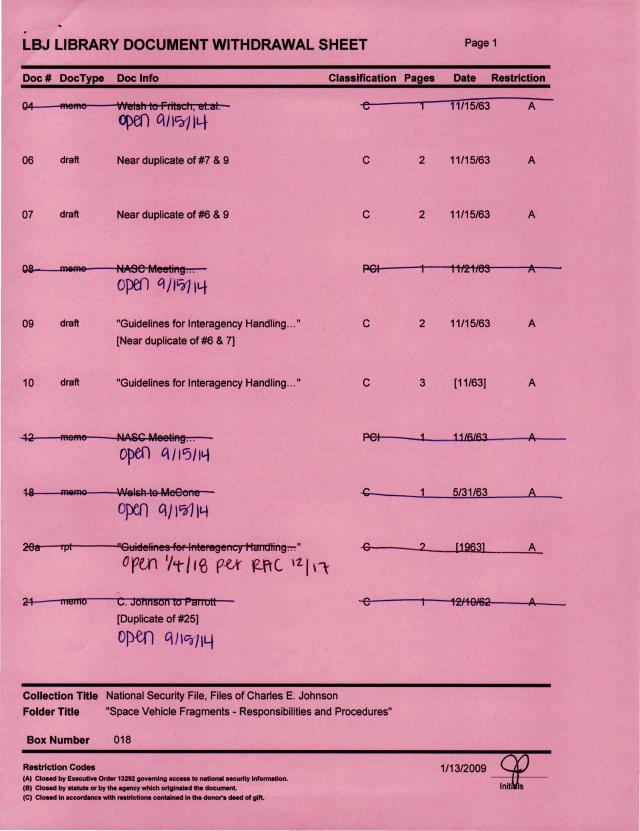 First page of the LBJ Library folder on space vehicle fragments (USG-UAP-D002). U.S. Department of War. | |
| Dates | Oct. 1962 – May 1964 |
|---|---|
| Source | LBJ Library, National Security File (files of Charles E. Johnson); Executive Office of the President |
| Agencies | National Aeronautics and Space Council; NASA; DOD; CIA; AEC; State |
| Released | Release 07 (Oct. 23, 2026) |
| Files | 2 (PDF): USG-UAP-D002 (72 pp.) and EOP-UAP-D002 (1 p.) |
| Previously public? | Partly; many items in the LBJ Library folder were opened in 2014 |
| Official releaseHistorical | |
In October 1962, Edward C. Welsh, executive secretary of the National Aeronautics and Space Council, began an interagency effort to decide who should receive, analyze and identify fragments of space vehicles falling on U.S. territory or coming into U.S. hands. The resulting paper trail, preserved in a Lyndon B. Johnson Library folder, runs through May 1964.[1]
The draft guidelines
The drafts quickly settled on NASA as lead agency, with the Defense Department solely responsible for fragments of its own launches. The harder question was foreign debris. By March 1963 the Defense Department wanted foreign fragments, “including whole vehicles,” sent to it first for analysis for intelligence purposes, then to NASA for custody pending return or other disposition. The Atomic Energy Commission would handle radioactive material, the State Department would give policy guidance and help recover fragments that land abroad, and NASA would be the public-information focal point. A CIA objection in December 1962 created what an NSC staffer called a jurisdictional “tempest in a tea cup.”[1]
The file includes meeting lists (including a November 6, 1962 session in the Executive Office Building), redlined drafts, a proposed public statement, an October 1963 Space Council memo to the heads of State, CIA, Defense, NASA and others, and 1964 NASA public-affairs guidance. One NASA message says that “under no circumstances” will the government conjecture on the origin of an object after a reported impact; it wants to obtain, analyze and establish the origin first, with a public announcement after analysis.[1]
The Hale memo (May 29, 1963)
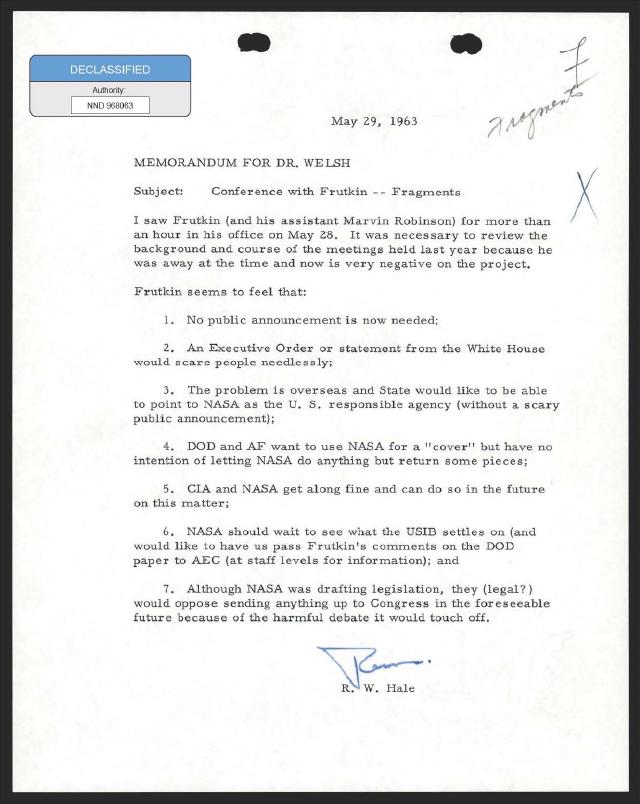
EOP-UAP-D002 is a one-page memorandum from R. W. Hale of the Space Council staff to Welsh on a meeting with NASA’s Arnold Frutkin. Hale writes that Frutkin was “very negative on the project” and lists his views: no public announcement is needed, a White House statement would “scare people needlessly,” the problem lies overseas, and the Defense Department and Air Force “want to use NASA for a ‘cover’” while intending NASA to do little beyond returning some pieces. The remark about a “cover” is the line most likely to be quoted.[1]
Analysis
The papers show Washington working out, in the early space age, a procedure for foreign and unidentified objects that fall to Earth, and the friction among intelligence, defense and civilian space agencies over who controls them. That is context for later discussions of recovered materiel, not evidence about UAP. Another 1963 Space Council memo, discussing “the space alien race question,” appears on the State Department UFO memos page from Release 01.
The records
USG-UAP-D002, Interagency Correspondence Concerning Space Fragments (1962–1964)
Open USG-UAP-D002 (PDF, 36.8 MB) → · original on war.gov
This file contains a series of memoranda and correspondence exchanged among senior Executive Branch officials between October 2, 1962, and May 26, 1964, concerning the development of a policy framework and communications strategy for the recovery, handling, analysis, and disposition of materials associated with U.S. and foreign activities in space. Over the course of multiple drafts and revisions spanning nearly two years, the file documents efforts to establish jurisdictional boundaries based on the suspected origin and character of recovered material. In general, the proposed framework contemplated that material associated with a U.S. Department of Defense mission or equipment would be received, analyzed, and disposed of by the Department; that foreign space material would be turned over to the Department of Defense or the National Aeronautics and Space Administration (NASA), depending on the circumstances; and that the Department of State would coordinate with foreign governments to secure access to such material when recovered abroad. The correspondence also reflects efforts to assign responsibility for hazardous or radioactive materials to the Atomic Energy Commission. Various drafts alternated between assigning responsibility for handling materials whose origin could not be readily determined to the Department of Defense or to NASA. The correspondence also reflects concern with public perception regarding recovery activity and includes draft public statements describing the proposed framework. This public messaging included language designating NASA as the holding authority for foreign materials, while private correspondence described a parallel plan to exploit such materials for technical analysis. Ultimately, although these negotiations did not produce a settled policy framework, the correspondence illustrates interagency deliberations between senior officials in the context of the Space Race and the broader Cold War between the United States and the Soviet Union.
EOP-UAP-D002, Memo on Interagency Coordination for the Recovery of Foreign Materiel (May 1963)
Open EOP-UAP-D002 (PDF, 143 KB) → · original on war.gov
This document is an internal National Aeronautics and Space Council (NASC) memorandum from staff member R.W. Hale to Executive Secretary Edward C. Welsh. NASC was a 1958–1973 body within the Executive Office of the President responsible at the time for coordinating U.S. space policy. The memorandum records a May 28, 1963, meeting with Arnold Frutkin, Director of International Programs at the National Aeronautics and Space Administration (NASA), concerning the development of a coordinated interagency policy for recovering reentering U.S. and Soviet space debris and satellite fragments that might land on foreign soil. This memorandum is associated with a larger body of interagency correspondence included in this collection under the title “USG-UAP-D002.” The memorandum highlights an interagency policy debate over organizational jurisdiction during the early Space Race. It states that the Department of State and Department of War sought to leverage NASA’s standing as a civilian scientific agency to help facilitate discreet recovery of sensitive space hardware while publicly returning non-sensitive components to the country of origin. As described in the memorandum, the proposed arrangement would have served several purposes: enabling access to adversary technologies, protecting U.S. technologies, preserving diplomatic goodwill, and obscuring the intelligence gathering dimension of technology recovery operations. The memorandum also presents Director Frutkin’s reaction to the proposed arrangement as “very negative.”
Released files
| PURSUE ID | Title | Incident | Type |
|---|---|---|---|
| USG-UAP-D002 | Interagency Correspondence Concerning Space Fragments, 1962-1964 (war.gov) | 1962-1964, Washington, D.C. | |
| EOP-UAP-D002 | Memorandum on Interagency Coordination for the Recovery of Foreign Materiel, May 1963 (war.gov) | 5/29/1963, Washington, D.C. |
See also
- PURSUE Release 07 (Oct. 23, 2026) overview
- Key Disclosure Documents
- Edward C. Welsh
- National Aeronautics and Space Council
- NASA
- State Department UFO memos and cables (1952–2004)
- CIA
- PURSUE
References
- ^ U.S. Department of War (2026). PURSUE Release 07 (Oct. 23, 2026): USG-UAP-D002, EOP-UAP-D002, with official descriptions. war.gov/ufo.